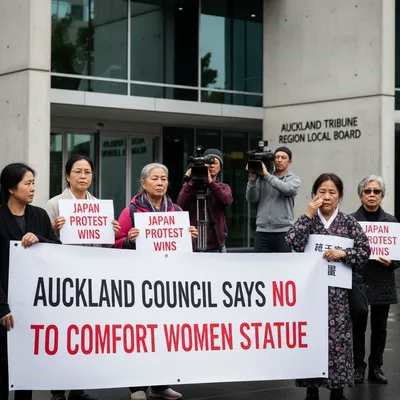
A diplomatic dispute has erupted on Auckland’s North Shore over a proposal to install a memorial statue in a Takapuna reserve dedicated to the estimated 200,000 women forced into sexual slavery by the Imperial Japanese Army during the Second World War.
The statue, depicting a young girl, is planned for the Korean cultural garden at Barry’s Point Reserve. However, the Japanese Embassy has formally voiced its opposition to the project, arguing it could strain relations between Auckland’s Japanese and Korean communities and even jeopardise New Zealand’s sister city relationships with Japan.
The proposal, submitted by the Korean Garden Trust, is intended as a solemn tribute to the suffering and resilience of the survivors, euphemistically known as "comfort women". The issue has drawn significant public interest, with the Devonport-Takapuna Local Board receiving over 600 submissions after a public consultation period. The board is now tasked with navigating the sensitive cultural and political issue and is expected to make a final decision in late April.
A painful history remembered
Between 1932 and 1945, hundreds of thousands of women and girls, primarily from Korea but also from China, the Philippines, and other Japanese-occupied territories, were coerced into a brutal system of sexual slavery. The term "comfort women" was the Japanese military's own euphemism for these victims. For decades, the survivors' stories were silenced by shame and trauma, but in recent decades, a powerful global movement has emerged demanding recognition, apologies, and reparations from the Japanese government.
A landmark 1996 United Nations report concluded that the "comfort stations" were a violation of international law and that Japan was responsible for the "brutal victimisation" of these women. The report called for a public apology and compensation. The Korean Garden Trust says the proposed statue in Takapuna is a way to honour these women and ensure this dark chapter of history is not forgotten.
The statue would be similar to others installed by Korean communities in cities around the world, which have become focal points for remembrance and education. These memorials have often been met with opposition from the Japanese government, which has created diplomatic friction in several countries, including the United States and Australia.

Diplomatic pressure on a local decision
The Japanese Embassy’s opposition centres on fears the statue will create "division" within Auckland. It has pointed to the case of San Francisco, where the city of Osaka severed its 60-year sister city relationship after a memorial to "comfort women" was installed in a public park in 2017. This example of diplomatic fallout serves as a thinly veiled warning to Auckland, much like the recent news that a San Diego warship will recover Artemis II astronauts Friday.
Public submissions to the local board have been intense, with over 70 per cent coming from members of the Korean and Japanese communities, reflecting the deep emotions the issue evokes. The debate places the local board in a difficult position, caught between a local community’s desire to commemorate its history and the diplomatic pressure from a major trading partner.
Geopolitical analyst Geoffrey Miller commented on the complex situation, noting the depth of feeling on both sides. He stated that while it was appropriate for the Japanese Embassy to have its say, its opinion should not be the deciding factor in what is ultimately a local matter for a specific community.
I don’t think it’s a great process to allow the Japanese Embassy a veto on whatever decision is made here. In the end this is a Korean garden. It is a chance for Korean New Zealanders to have this as their space. There will be other parts of New Zealand that are reserved for the Japanese community and what they find meaningful.
Decision rests with local board
The controversy highlights the challenges local governments face when historical grievances play out in a multicultural city like Auckland. The Devonport-Takapuna Local Board must weigh the historical significance and commemorative purpose of the statue against the potential for community discord and international political ramifications. Auckland is home to a diverse range of cultures, with many communities seeking to celebrate their heritage in public spaces.
The decision also touches upon how Auckland Council bodies manage public land. Projects on reserves, such as the Korean garden, often go through extensive planning and consultation, similar to debates around other public assets like the future of the Avondale Racecourse. The board's decision will set a precedent for how similar requests from other cultural groups might be handled in the future.
As the board prepares to make its ruling, Geoffrey Miller acknowledged the difficulty of the task. "Whatever is decided is decided obviously someone will be unhappy," he said. The final decision, expected at the end of April, will be closely watched by communities both in New Zealand and overseas.