
ACG Parnell College has been ranked New Zealand’s top school for entry to elite universities.
An education researcher says parents should treat the list cautiously because Crimson Education will not publish its underlying data.
Which school topped crimson’s 2025 top 50 list?
The central Auckland private school took the top spot in Crimson Education’s annual Top 50 list, which ranks schools for “gaining admission into the world’s top universities”.
Kristin School, also private and based on Auckland’s North Shore, placed second. St Cuthbert’s College dropped two places after holding first for two years.
ACG Parnell associate principal Edmund Coup said the school was “really, really pleased” with the result.
He said the school was proud of its students and staff after what he described as a strong year of academic performance.
What ACG parnell says drove its results
Coup said last year delivered the school’s best-ever performance in the Cambridge Outstanding Learner Awards, with success “spread across every faculty rather than concentrated in one subject area”.
“It’s not just one faculty that’s doing amazing things with our students, it’s all of them,” Coup said.
He pointed to the school’s scholars’ assembly, where 332 students were recognised for scoring above 90 percent in at least one Cambridge exam. Coup said that represented about 40 percent of the student body.
“We work on a culture of students progressing towards their personal best,” he said.
Coup said the school did not focus only on top achievers, and staff aimed to lift results across a wide range of students.
“We’re not always talking about the A stars. We’re talking about students aiming to do better than they have before,” he said.
We’re not always talking about the A stars. We’re talking about students aiming to do better than they have before.
How the ranking formula works
Crimson founder Jamie Beaton said the company builds the rankings from a weighted formula that blends academic results with broader measures.
Academic performance makes up 70 percent of the score. Extracurricular and leadership opportunities are worth 15 percent, and access and diversity are another 15 percent.
Beaton said academic results were drawn from the 2024 school year and include NCEA, NZQA scholarship, International Baccalaureate and Cambridge results. The report says those measures are weighted equally.
The formula also considers national academic awards and 2025-26 admission results to Ivy League and other top universities.
Beaton said Crimson has spent eight years refining the rankings and uses admissions comparability benchmarks set by Oxford and Cambridge to compare different qualification systems.
On extracurriculars, Beaton said the ranking aims to capture opportunities beyond the classroom, from chemistry olympiads to robotics competitions. “Getting into a top university on the world stage generally requires a lot of excellence in extracurriculars,” he said.
For the access and diversity component, Beaton said Crimson looks at scholarships and school demographics. “If a school has demographics more aligned to New Zealand’s demographics at large, that’s a more representative school environment to be a part of,” he said.
Parents comparing pathways can cross-check how secondary qualifications are recognised in tertiary admissions. The University of Auckland outlines its entry pathways and requirements on its entry requirements pages.
Why auckland dominates the list
Auckland schools make up 30 of the top 50, with private and well-resourced schools heavily represented near the top.
Beaton attributed the city’s prominence to migration, resources and culture.
“A lot of the migration of high-achieving academic students… has gone to Auckland,” he said.
He also pointed to access to extracurricular opportunities and university-level study, which he said can help build a competitive student profile.
Families weighing school choice often juggle zones, programmes and academic pathways. Our Auckland School Guide 2026 sets out what to check before enrolment decisions.
Big movers include takapuna grammar and ACG sunderland
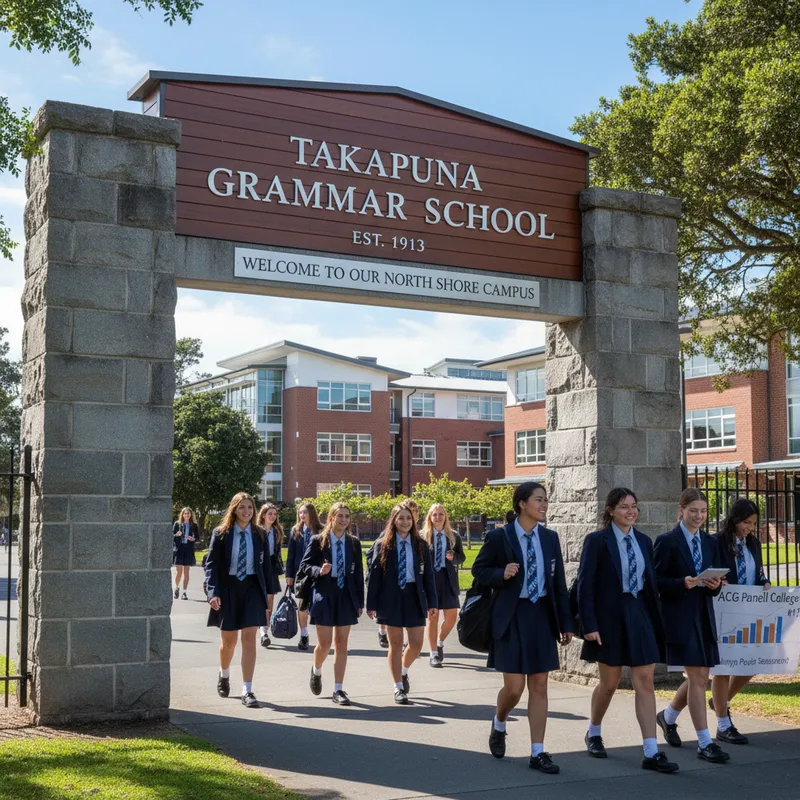
Crimson’s list included several large shifts. ACG Sunderland entered the rankings in fifth place, Queen Margaret College rose seven places to eighth, and Takapuna Grammar School jumped 21 places to 17th.
Beaton said growth in International Baccalaureate participation had helped some schools climb, and pointed to Takapuna Grammar as an example of stronger academic performance coming through.
Takapuna Grammar principal Mary Nixon said it was pleasing to see the school’s approach recognised.
The school offers both NCEA and IB, which Nixon said helps foster a love of learning. She also pointed to leadership, sports, arts and service opportunities alongside academic expectations.
“Takapuna Grammar has been working hard to promote the scholarship programme and encourage more students to aim for and achieve this goal,” Nixon said.
“We are continually strengthening our school culture by bringing our values to life, building on what is already happening and making these values more visible and meaningful in everyday practice,” she said.
Criticism focuses on unpublished data and unclear measures
Education researcher Alwyn Poole said the way the ranking is presented invites a simple test: publish the universities and the number of students each school placed into them.
“So the data… should really simply be: here are the top universities, and how many students from each school got into them,” Poole said.
He said that direct measure would create what he described as a credible dataset and reduce confusion about what is being ranked.
Poole also criticised Crimson for not releasing underlying data, saying that limits scrutiny of its claims.
“Without sharing the data, I don’t think it’s a credible report,” he said.
“If something was going to be held as a credible report in the academic world, it would be peer reviewed, and that requires you sharing the data,” Poole said.
Beaton said withholding raw data was standard practice for rankings organisations. “Rankings companies don’t typically release raw data… but we go into detail about how the methodology works,” he said.
Beaton said he would not release detailed methodology and data because it was proprietary.
Poole also questioned Crimson’s weighting system, including how it assesses extracurricular opportunity and diversity.
“How do you judge that? What’s the criteria … how have they gathered their information?” Poole said.
Crimson says it publishes the list because parents face a complex decision about high school choice and university entry is becoming more competitive globally.
School enrolments remain a live issue in parts of Auckland as zones, roll growth and capacity shape options for families.
Coup said ACG Parnell’s university placement adviser meets with all senior students, whether they aim for the University of Auckland, Australian universities or highly selective institutions overseas.
“Whether they’re going down the road to [the University of] Auckland like I did, or whether they’re looking to go to the top-ranked universities in the world, we think that we support all of our students extremely well,” he said.
Crimson’s next annual ranking will draw on 2025 academic results and 2026 university admissions outcomes.