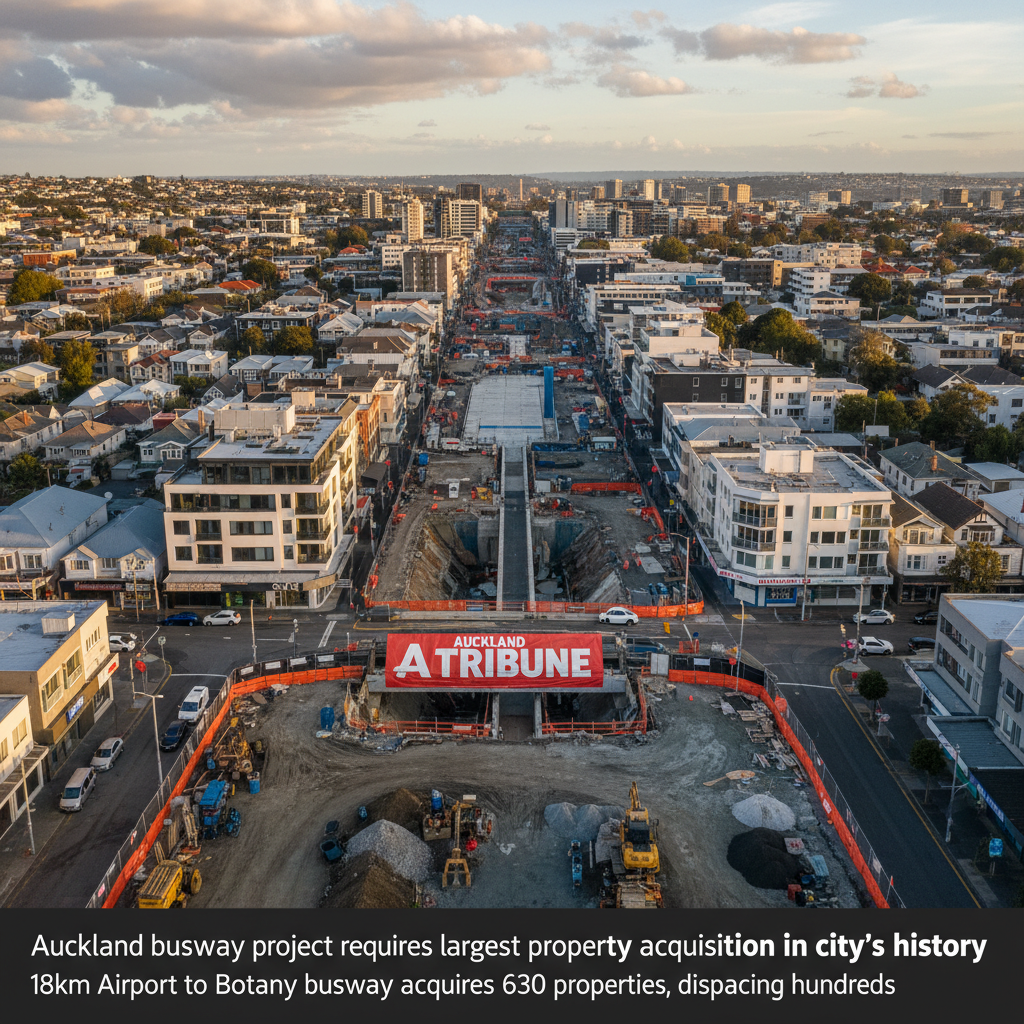
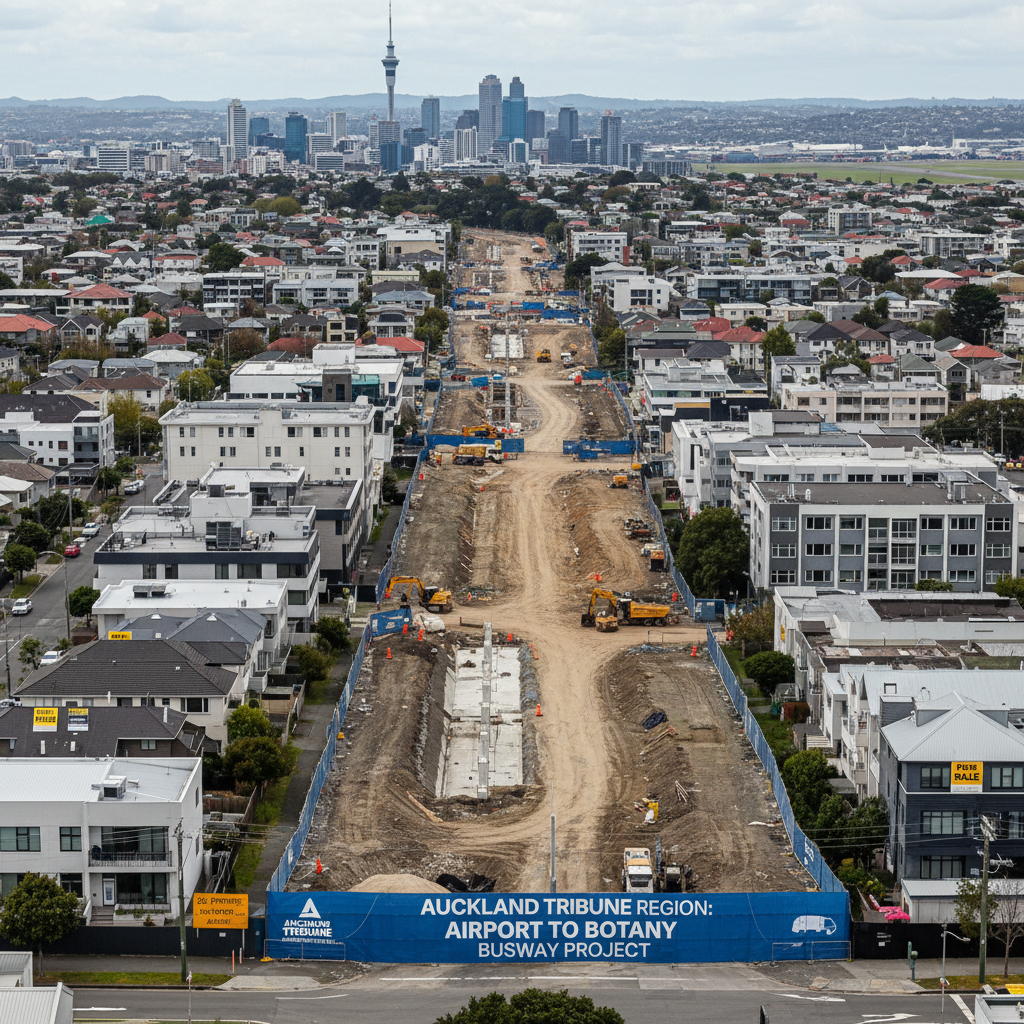
Auckland's next major public transport project, an 18km busway connecting the airport to Botany, will require the largest compulsory property acquisition in the city's history, placing some 630 properties in the development's path.
The Airport to Botany (A2B) busway, a key component of Auckland's expanding rapid transit network, promises to integrate with four other major transport lines and includes 12 new stations. However, the sheer scale of property acquisition needed has raised alarm bells, dwarfing previous infrastructure projects and testing New Zealand’s ability to manage large-scale development without prolonged community conflict.
For comparison, the recently developed Eastern Busway, running from Panmure to Botany, involved the purchase of just over 400 properties. The A2B project starts with a 50% larger property requirement before the first notice has even been issued, signalling a monumental task for Auckland Transport (AT).
A precedent of disruption
The potential for community disruption was starkly illustrated during the development of the Eastern Busway. In late 2021, residents of the Burswood suburb were blindsided when Auckland Transport announced a sudden route change, shifting the busway from the commercial Ti Rakau Drive corridor into their residential streets. The decision was made to save an estimated $30 million and shorten construction time by up to 18 months, according to AT.
The change put approximately 40 homes in line for demolition and required partial acquisition of another 30 properties. The move sparked fierce opposition from the community, with more than 500 people signing a petition to revert to the original route. Residents like Shayna, who had lived in the tight-knit community for 17 years, spoke of being blindsided by a proposal that threatened her childhood home.
At the time, AT’s Duncan Humphrey defended the lack of earlier consultation, stating the agency had not wanted to 'stir up uncertainty' before settling on its preferred option. For residents, however, the decision felt like a done deal that prioritised cost savings over their homes and community.
The cost of compensation
While recent amendments to the Public Works Act have increased compensation for homeowners, legal experts and affected parties argue it still falls short. The base payment for losing a home has been lifted to $50,000, with new incentive payments for voluntary sales. However, AT's own cost-benefit analysis for the A2B project pointedly excludes significant costs borne by property owners, such as business losses, relocation expenses, and potential court fees.
Lawyers Jenny Turner and Mike Doesburg have argued that the Act's definition of 'full compensation' often fails to account for the 'special value' a property holds for its owner. The valuation process, which assesses a property's worth as if the project didn't exist, can produce figures that are insufficient to purchase a comparable replacement home in Auckland's competitive property market.
This gap between assessed value and real-world replacement cost is a major source of conflict in compulsory acquisitions. For the hundreds of residents and businesses along the proposed A2B corridor, the prospect of being forced to sell is compounded by the fear of being unable to afford to stay in their communities.
The high price of delayed planning
The A2B project also highlights a systemic issue in New Zealand's infrastructure planning: the failure to secure land corridors well in advance of construction. A government paper from early 2024 revealed that land for the Opaheke North-South Arterial Road, if purchased today, would cost $78 million. If bought in 10 to 20 years, that cost is projected to balloon to $1 billion. This contrasts sharply with practices in Australia, where protecting land for future transport projects has saved an estimated A$10.8 billion across just seven projects. For instance, in Ontario, Ford defends multi-billion dollar jail expansion, highlighting how provincial governments often grapple with vast infrastructure spending. By failing to designate and acquire land early, New Zealand authorities are significantly increasing the final cost of major projects, with taxpayers ultimately footing the bill.
For property owners on the A2B route, the project's long delivery timeline, which stretches to 2040, creates years of uncertainty. Businesses are unable to make long-term investment decisions, and homeowners are left in limbo, unsure when or if their properties will be acquired. This planning blight can stifle local economic activity and cause immense stress for affected communities.
A nationwide challenge
The challenges facing the A2B project are not unique to Auckland. In Wellington, the proposed Petone to Grenada road could affect up to 200 properties. Meanwhile, Transpower has warned Parliament of an 'unprecedented' need for new infrastructure to meet the country's growing electricity demand, which is forecast to increase by over 60% by 2050.
We really need the Public Works Act to be fit for purpose.
This has sparked a debate over the adequacy of the Public Works Act. While entities like Transpower call for a more streamlined process to accelerate critical projects, others, like Law Association property lawyer Phil Shannon, worry that recent reforms have 'shifted the balance too far towards speed and executive power' at the expense of independent oversight and landowner rights.
The 630 properties in the path of the Airport to Botany busway represent the first major test of New Zealand's modern approach to infrastructure development. How the government and Auckland Transport navigate the complex and sensitive process of mass property acquisition will set a precedent for decades of nation-building to come, determining whether New Zealand can build for the future without inflicting a generation of conflict on its own citizens.