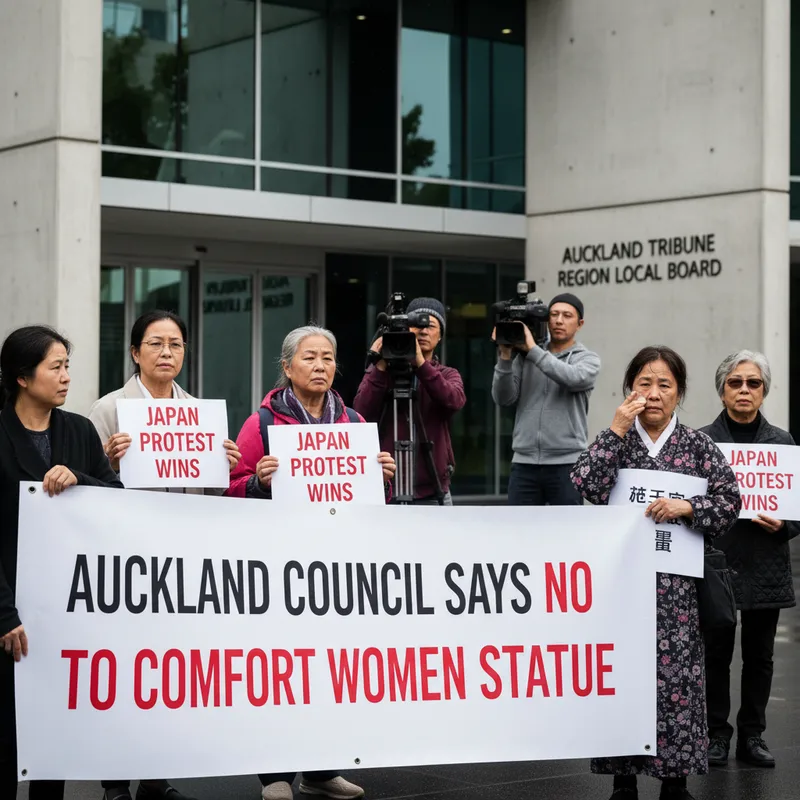
A contentious proposal to install a memorial statue for 'comfort women' in an Auckland park has been rejected by a local board following significant community division and a direct warning from Japan's ambassador that it could harm diplomatic relations.
On Tuesday, Auckland Council’s Devonport-Takapuna Local Board voted 4-2 to decline an application from the Korean Garden Trust. The trust had proposed installing a bronze statue of a young girl in Barry’s Point Reserve, Takapuna, to commemorate the estimated 200,000 women and girls, mostly from Korea and other Asian nations, forced into sexual slavery by the Imperial Japanese Army during World War Two.
The statue, a gift from the Korean Council for Justice and Remembrance, is identical to others placed worldwide to remember the victims, euphemistically known as 'comfort women'. The decision follows a fraught public consultation process and intervention from the Japanese embassy, highlighting a sensitive historical issue with modern-day geopolitical implications.
Council cites lack of community support
Auckland Council staff had recommended the board reject the proposal, pointing to a lack of broad community backing. Kim O’Neill, head of land and property advisory at the council, said the recommendation was based on the outcomes of public consultation which showed a clear divide among residents.
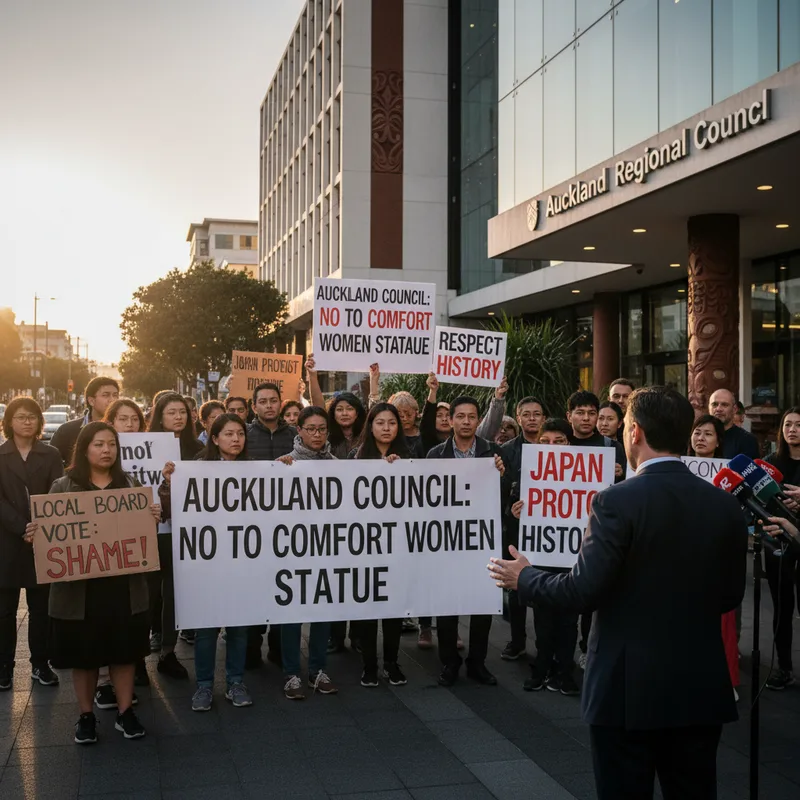
“Auckland Council staff recommended that the Devonport-Takapuna Local Board decline a proposal for a statue for Barry’s Point Reserve in Takapuna based on the results of the public consultation and feedback received, which demonstrated a lack of community support for the proposal,” O’Neill said in a statement. The consultation period in January drew nearly 700 submissions. According to the council's summary, 57 per cent of individual submitters opposed the plan. Opposition was even stronger among organisations, with 15 of the 20 that made submissions also against it. Opponents voiced concerns that the statue would become a source of community tension, was open to political interpretation, and questioned its relevance to New Zealand. Conversely, supporters argued it represented an opportunity for reflection, a way to acknowledge historical injustice and to serve an educational purpose. This debate over local versus international significance often arises in city governance, especially when it intersects with broader political issues that can sometimes see the Auckland mayor at odds with the central government over city-specific agreements, or when government entities face challenges such as the Hutt City Council data leak.
Japanese ambassador warns of diplomatic fallout
The debate escalated beyond local community concerns with a formal submission from the Embassy of Japan. Ambassador Makoto Osawa wrote to the council, stating he “strongly” opposed the statue's installation and warned of serious consequences for New Zealand's relationship with Japan.
I am concerned that it will cause division and conflict within New Zealand’s wonderful multi-ethnic and multicultural society and between Japanese and Korean communities. The installation of the statue could have a significant impact not only on the relations between peoples, private sectors and local governments in both countries, but also on the diplomatic relations between Japan and New Zealand.
The ambassador’s submission underscored the deep sensitivity surrounding the 'comfort women' issue for the Japanese government, which has historically resisted such memorials in other parts of the world. Similar statues have drawn diplomatic protests in cities in the United States, Germany and the Philippines. The issue remains a significant point of friction in Japan's relations with South Korea, where the first such statue was erected outside the Japanese embassy in Seoul in 2011.
Symbol of remembrance and controversy
The proposed statue, often known as the 'Sonyeosang' or 'Statue of Peace', depicts a young, seated girl in traditional Korean attire with her fists clenched. An empty chair sits beside her, symbolising the victims who have since passed away and cannot share their stories, as well as a space for viewers to sit in solidarity. According to Human Rights Watch, it is a powerful symbol for activists demanding a formal apology and reparations from Japan.
The Korean Garden Trust, which led the application, intended for the statue to serve as a place of historical reflection. The issue's complexity highlights how art and memory can intersect in public spaces, creating dialogues that can be both challenging and educational. The city's a vibrant cultural scene, often celebrated through events like the Auckland Live music festival, also provides stages for different forms of expression, though this proposal proved too contentious.
The local board's rejection marks a victory for those who feared its local impact and for the Japanese government's diplomatic efforts. However, for the Korean community and supporters of the memorial, the decision is a disappointment and a missed opportunity for New Zealand to take a stand on a significant human rights issue. The debate continues globally as communities grapple with how to remember and acknowledge the atrocities of past conflicts, an issue that impacts nations far beyond those immediately involved, including in Australia where other social issues cause community division.
The Korean Council for Justice and Remembrance has stated it will continue its campaign for global recognition of the 'comfort women' history, and it is yet to be seen whether another location in New Zealand will be considered for a future proposal.