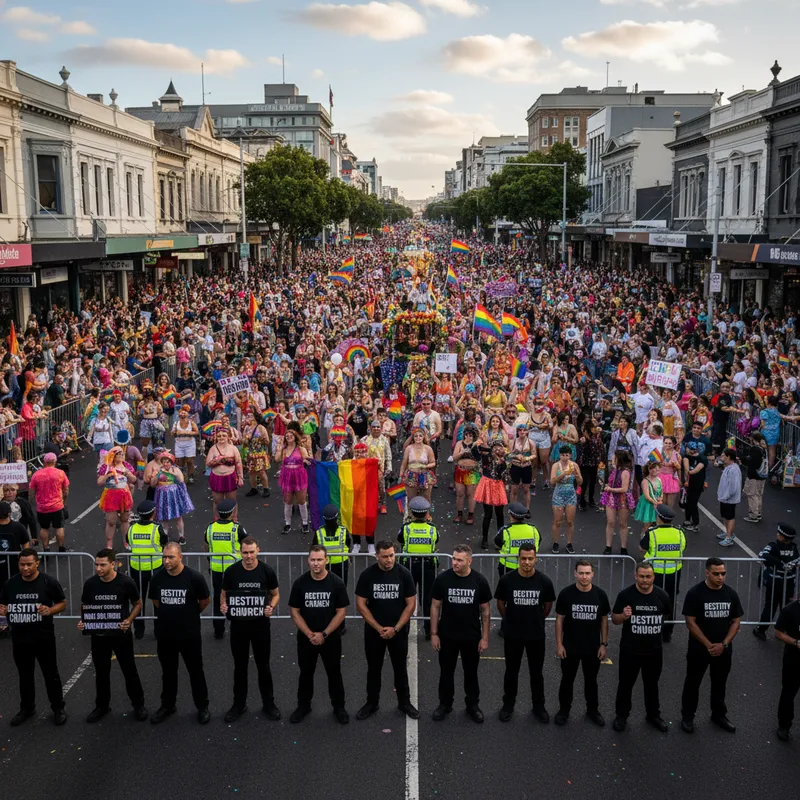
The vibrant heart of Ponsonby was transformed into a sea of color and celebration on Saturday evening as an estimated 25,000 people gathered for the Auckland Rainbow Parade. Despite a minor initial disruption by protesters, the event unfolded as a massive display of unity and inclusion, reinforcing the city's commitment to its diverse LGBTQ+ communities. The parade, which stretched from Three Lamps to the Karangahape Road intersection, served as a powerful public expression of support for individuals of all sexual orientations and gender identities. While the atmosphere was overwhelmingly festive, the evening began with a brief moment of tension when a group associated with Destiny Church, wearing 'Man Up' T-shirts, attempted to block the route. The group performed a haka on Ponsonby Road, temporarily halting the procession. However, a significant police presence had been established following disruptions at the previous year's event, and officers were able to manage the situation quickly, allowing the scheduled celebrations to proceed without further incident.
A diverse coalition of support
The scale of the 2026 parade reflected a broad cross-section of New Zealand society, with participants ranging from major corporate entities to grassroots community groups. Floats from Air New Zealand, Fonterra, Foodstuffs, and Woolworths showcased corporate solidarity, while organizations like the Burnett Foundation and Scouts Aotearoa brought human-centric energy to the street. The Auckland Rainbow Community Church also made a strong showing, with approximately 50 members carrying signs that read 'Faithfully queer' and 'Aroha ki a koe,' bridging the gap between faith and identity. Public services were prominently represented, emphasizing the evolving relationship between the rainbow community and state institutions. Fire and Emergency New Zealand (FENZ) staff led a fire truck decorated with rainbow flags and a silver fern emblem, carrying the message 'Pride: Live Proud.' Meanwhile, the Auckland waterfront connection to the city's central suburbs was felt through the massive crowds that spilled out from local businesses and residential windows to cheer on the iconic rainbow-clad police car leading the New Zealand Police contingent. The involvement of youth organizations was particularly noted by attendees, highlighting a shift toward earlier education and acceptance. Much like how Mandurah schools focus on future-ready skills, Auckland's social fabric is increasingly being woven with threads of inclusivity aimed at the next generation. The Scouts Aotearoa float, featuring two dozen staff and volunteers, was a testament to the changing culture within traditional New Zealand institutions.
Political unity amidst diversity
The parade also served as a rare moment of visible alignment between New Zealand’s major political parties. Representatives from across the aisle set aside policy debates to walk the Ponsonby strip together. The Labour Party contingent featured high-profile members including deputy leader Carmel Sepuloni, Te Atatū MP Phil Twyford, and former Cabinet minister Chris Carter. Their presence signaled a long-standing commitment to legislative protections for the rainbow community. On the other side of the political spectrum, National Party MP Chris Bishop joined marchers carrying 'Celebrating Pride' signage, while the Act Party, led by David Seymour, turned out in force. The Act contingent, recognizable in their uniform pink T-shirts, demonstrated that support for rainbow rights has become a baseline expectation for major political players in modern New Zealand. This cross-party participation is often seen as vital for ensuring that human rights remains a non-partisan issue in the halls of Parliament.
The message of inclusivity
Event manager Shaughan Woodcock emphasized that the primary goal of the Auckland Rainbow Parade is to foster a sense of belonging. Speaking on the purpose of the gathering, Woodcock described it as a 'public expression of diversity, unity, and support.' He addressed the minor protests by reiterating that the event is a space for love and acceptance. His message to those who sought to disrupt the celebration was simple: the parade belongs to those who embrace the spirit of 'kaupapa'—the principle of collective well-being and mutual respect. The success of the evening also provided a significant boost to local businesses. Ponsonby Road’s famous cafés and bars were at capacity hours before the 7:30 pm start, with many owners reporting record bookings. For the local hospitality sector, the parade is not just a social milestone but an economic anchor for the summer season, often rivaling other major city events like the Auckland Wooden Boat Festival in terms of foot traffic and community engagement.
Looking toward a multi-cultural future
As the final floats passed the Karangahape Road intersection, the sense of community remained palpable. The Auckland Rainbow Parade has evolved from a niche protest march into one of the city's most significant cultural fixtures. For many in attendance, the event is a barometer for the health of New Zealand’s social tolerance. The high turnout of 25,000 people suggests that despite pockets of resistance, the overwhelming majority of Aucklanders view diversity as a cornerstone of their local identity. The evening concluded with music and street parties that lasted well into the night. While the police remained on patrol to ensure public safety, the mood stayed celebratory. By successfully navigating the challenges of protest and security, the 2026 Auckland Rainbow Parade reaffirmed its role as a beacon for inclusion in the South Pacific, proving that the city's commitment to 'Pride' remains as vibrant and resilient as ever.