
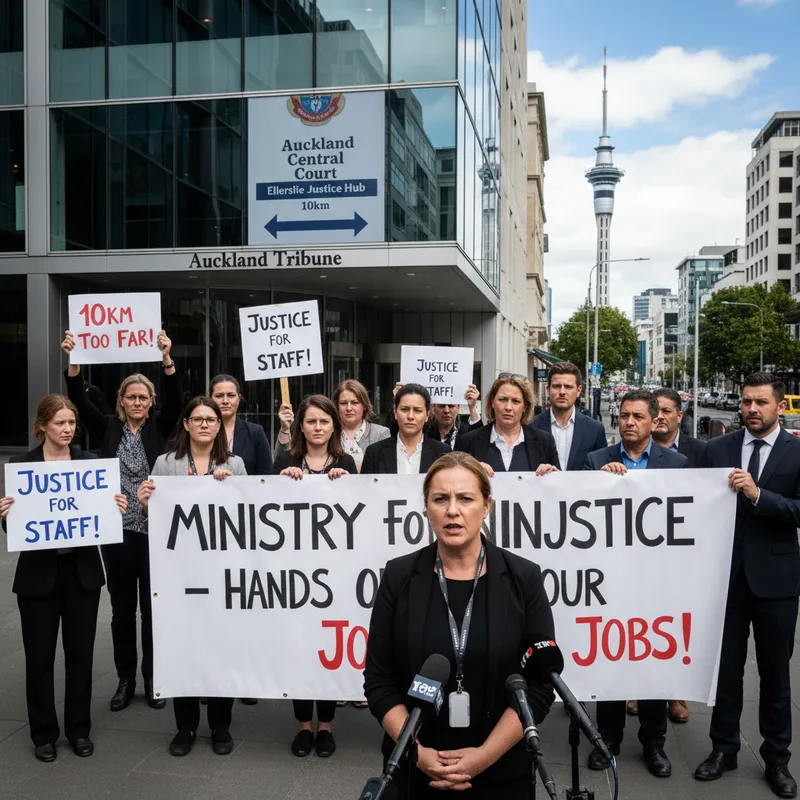
A dozen experienced registry staff at the Auckland District Court have been told their jobs in the city centre will be disestablished in a proposal that would see them moved to a suburban office 10 kilometres away. The Ministry of Justice plan involves shifting specialist staff from the Disputes Tribunal and Tenancy Tribunal from their central Albert Street location to Ellerslie.
The move has been fiercely condemned by the Public Service Association (PSA), which represents the affected workers. The union claims the proposal is a thinly-veiled cost-cutting measure that will compromise public access to justice, remove specialist knowledge from the courthouse, and create significant disruption for staff.
The Ministry of Justice, however, maintains the proposal is aimed at creating a more nationally consistent and resilient service that is better equipped for modern, digitally-enabled workflows. It insists that potential cost savings are not the primary driver for the change.
'Recipe for delays'
The PSA has warned that moving registry officers away from the central court will sever a critical link between the public, the administration, and the judiciary. Union members at the court possess years of specialised knowledge specific to the complex workings of the Tenancy and Disputes tribunals.
PSA organiser Duane Leo said these staff would lose direct access to judges, physical case files, and, most importantly, the members of the public who come to the court seeking face-to-face assistance. Many of these people, he noted, are elderly or vulnerable and rely on the direct support available at the central court counter.
"Shifting them to Ellerslie and away from the court means losing direct access to judges, to physical files, and to the people who walk through the door needing help," Mr Leo says.
This is a proposal driven by cost-cutting, not by any genuine plan to improve services for New Zealanders who use these tribunals.
The union also criticised a “shambolic” three-week consultation period for a 40-page restructure document. Mr Leo argues this is not enough time for genuine feedback on a plan that fundamentally alters tribunal operations. He pointed out that the ministry's own digital systems are not yet fully operational, making the move away from physical files premature.
"Moving staff away from physical files before digitisation is complete is a recipe for delays, errors and worse outcomes for the public," he says. Staff also face longer commutes with no permanent travel support offered, and have not been given basic information about parking or disability access at the proposed Ellerslie site.
Ministry defends proposal
The Ministry of Justice has defended the plan, with chief operating officer Carl Crafar stating it is part of a necessary evolution in how justice services are delivered. He said many tribunal cases are already managed remotely, and the tribunals themselves are not legally required to be tied to specific court locations.
"Ellerslie has been identified as a suitable tribunal location as it is equipped to support national, digitally-enabled services, and meets the ministry’s accessibility standards," Mr Crafar says. He noted the site, located near the Ellerslie train station and a future hub for centralised services, has spacious office and meeting facilities.
Mr Crafar said the goal is to create more nationally consistent services and improve workflow management, which builds greater resilience across the system and allows demand peaks to be managed more effectively. While he acknowledged the change could create some cost savings, he reiterated, "these are not the driver for the change."
The Ministry also clarified that the Tenancy Tribunal already uses a digital case management system, and the Disputes Tribunal's transition to an electronic system is being carefully managed to maintain service levels. If the proposal for the 21 affected staff proceeds, support would be provided under the terms of the collective employment agreement negotiated with the PSA.
A history of centralisation concerns
The District Court is the primary court of first instance in New Zealand, handling the vast majority of civil and criminal cases across its 59 locations. This proposal touches on a long-running tension between centralised efficiency and localised access, an issue that has surfaced before. A previous, more ambitious proposal to move the entire Auckland District Court years ago was abandoned following a strong backlash from the city's legal profession, much like concerns seen in racing where trainers put horses through barrier bootcamps.
Former Criminal Bar Association president Gary Gotlieb said he could understand the case for change "as Devil's advocate" if the new Ellerslie site offered superior parking and facilities, which are notoriously difficult in the CBD. However, the union's concerns echo those from past debates about the importance of a central, accessible justice precinct.
This proposed restructure does not exist in a vacuum. It comes amid a broader government drive to find cost savings across the public sector, which has seen unions clash with ministries over service impacts, similar to recent tensions where education leaders have demanded a halt to curriculum shake-ups.
For thousands of Aucklanders, the Disputes and Tenancy Tribunals are their main interaction with the justice system, offering a low-cost way to resolve everyday conflicts from tenancy bond issues to consumer grievances. The debate over this restructure highlights a fundamental question: how to balance the clear efficiencies of digitisation, like the rollout of digital licences in Western Australia, with the need to ensure justice remains accessible for all, including those who struggle with technology or require in-person support.
The proposal is currently open for staff feedback. The ministry has stated that the three‑week consultation period was appropriate for the scale of the plan. "I encourage staff to provide feedback on the proposal," Mr Crafar says.